

A Draft Introduction to Biography of Griffith Jenkins Griffith
L.A.'s First Philanthropist -- and Would-Be Wife Killer
Welcome to Digging History's first experiment in disrupting how history is researched and written. Below, a draft Introduction to the biography I’ve been working on contains two questions in bold and one poll — they're prompts to get feedback from you all! Please post observations in the comments section at the bottom of this blogpost. If you're reading this in an email, do not comment by clicking reply as that won't reach the entire group.
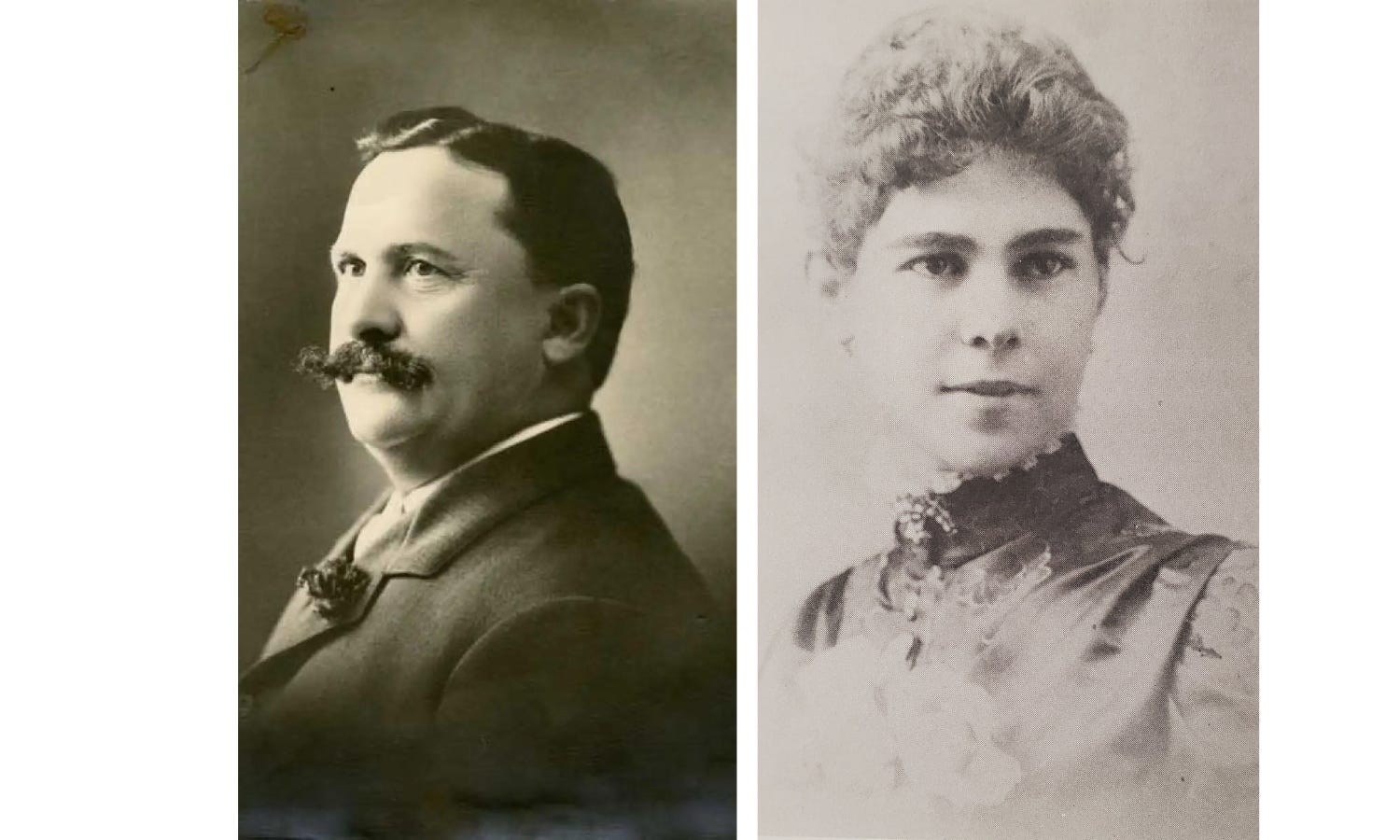
Why should you care about this story? A wealthy husband tries to kill his wife – that might get your attention at a dinner party, but to read an entire book about it? This story does have a “trial of the century”, but it seems every generation, in every city, has one of those. No, the reason for reading is deeper: it's the exploration of a "rise and fall” in a town and time of unique expansion. The United States was moving west, creating opportunities for those who knew how to seize them and turning a certain forsaken outpost into a mecca-city by the early 1900s and then the mega-city it is today.
I knew Griffith Jenkins Griffith, the rags-to-riches Welsh immigrant at the center of this story, and what fascinates me is this: His story wasn't supposed to end the way it did. (Thoughts about use of a narrator? I use it sparingly as a way to speculate/add my opinion, while hoping readers will understand that it’s not part of the historical record being presented. I reveal who the narrator is down below.) He was living the American Dream -- from poverty to fortune, family, fame and philanthropy. Rich by the time he was in his 30s, Griffith bought 4,071 acres of the Rancho Los Feliz outside Los Angeles and later, with his wife, donated 3,015 of those acres to create the world's largest urban park. That should have been plenty for an eternal legacy. But then Griffith threw it all away, shooting his wife in the face after accusing her of infidelity and of trying to poison him on behalf of the Catholic Church.
Today, Griffith Park is familiar to many a Los Angeles visitor and, I venture, to most Angelenos. But few know anything about its namesake, and fewer still know exactly how Griffith's American Dream unraveled. How, in one instant, Griffith's social status went from philanthropic visionary to ego-driven alcoholic and would-be wife killer -- a benefactor that time would soon forget.
Grif, as his friends and family called him, came to the United States from Wales as a teen in 1866 (I haven't been able to confirm this, which Griffith cited in his autobiography as having been on "The City of London” steamship, arriving in New York City that winter. Can anyone find a ship manifest with his name on it?) and within a decade had made a fortune in mining – well, actually in the art of mine speculation and possibly manipulation. More on that later. In any case, that fortune allowed him to buy most of the Rancho Los Feliz in 1882. Five years later Grif married a wealthy local, Mary Agnes Christina Mesmer, known by all as Tina, and soon a son was born. In December 1896, Grif was celebrated for the enormous Christmas gift to his adopted hometown. I state “Grif” because, even though Tina’s name was also on the deed and her fortune made it easier for Grif to part with 3,015 acres, it was Grif's initiative. Plus, it was still a man’s world and thus Grif got all the credit.
Others had, and have, donated smaller pieces of land to Los Angeles, or given millions of dollars to charity, but this gift was at another level. That made Grif not only Los Angeles’ first major philanthropist, but also one of its first socially aware visionaries. Parks are needed not as a retreat for the wealthy, he argued, but as safety valves for the working class living in cramped, unhealthy quarters. He later funded the Griffith Observatory and Greek Theater, both within the park, so as to bring science and art to the general public — gathering places where the classes could mingle. In other ways, too, he was ahead of his time -- or at least ahead of how his wealthy peers acted. A city needs industry, not just orange groves, he postured, and he put his money where his mouth was by starting a decorative tile factory that for a short time was one of the region’s largest employers. He also waged a very public campaign to turn punitive prisons into reformatories providing a second chance – a view he came to embrace after his own brief, but hard, time at San Quentin.
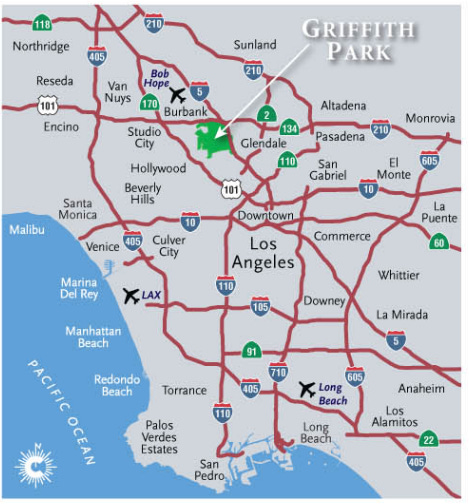
Alas, Grif’s charity and vision also came with an ego and heavy drinking. His rise and fall played out just as Los Angeles was evolving from a backwater into the envy of a mighty United States of America and its new, progressive president, Theodore Roosevelt. Los Angeles, too, had it all -- sunshine, beaches, plenty of farmland for those iconic orange groves, and even a shipping gateway from the Pacific Ocean to the Orient. Both Grif and I helped Los Angeles grow up, having arrived as outsiders in the early 1880s and quickly making our marks. He as a local financier/developer and me, Harry Chandler, eventually running The Los Angeles Times and, with the help of a new, controversial aqueduct, assembling the biggest real estate empire in the United States.
Through his story you can see not just an American Dream come and gone, you also get a sense of how California, particularly Southern California, became a mecca for dreamers around the 1900s. People like Grif and I anxious to make our mark in a promised land of sunshine, orchards and ocean.
Northern California boomed first thanks to its gold rush. The few who made fortunes there included Grif. Of those, many then parlayed their wealth into real estate, finance, railroads and/or trade. America had only recently connected the coasts by rail, and soon new shipping ports would expand opportunities across the Pacific Ocean. Grif and I were involved in all that.
I was driven by quietly influencing outcomes and amassing wealth -- and profited handsomely in the 1910s when Los Angeles diverted water from central California to open up the city's Inland Empire, where I had earlier bought real estate. Years later, a version of this was turned into the unflattering movie “Chinatown”.
Grif, on the other hand, had a flair for flaunting his position and wealth – both of which were enhanced by Mrs. Griffith J. Griffith, formerly Mary Agnes Christina Mesmer. The Mesmer family had status in Los Angeles, where her father was one of the first to make a fortune. And Tina had just inherited 200 acres of farmland ripe for development near downtown when Grif proposed marriage.
Given that the victim here was Tina you might ask: Why not tell her story? She's the one who suffered. True enough, but remember this was turn of the 20th Century. Women generally were led to keep low profiles, heck they couldn’t even vote in California until 1911, so little was documented about Tina’s life beyond social activities, and she left no diary or biography. It was still mostly a man's world to conquer or drown in -- and Grif did both in just 20 years, leaving behind an unpublished autobiography and, more importantly, a trail of newspaper reports from San Francisco, then Eureka, Nevada, and finally Los Angeles.
While both of us helped build Los Angeles, Grif had the potential for a richer legacy given his public munificence. And yet he died ostracized. Grif's burial was a sad affair with just us pallbearers and a minister paying respects. Local newspapers hardly mentioned it. The only saving grace for Grif was that readers were not reminded that he had been convicted of shooting his wife. The city's mainstream media, including my own Times, did not want to dredge up the embarrassment to the local elite caused by one of its own.
It’s hard to fathom how this could befall the man who donated what at the time was the largest urban park in the world, but then you haven't heard his story yet, have you?
I can't promise a full, completely accurate history. Nobody can when piecing together a life and times. Every story comes with perspectives shaped by how the protagonists see themselves and others -- and by how news media portray them. What I can do is bring those perspectives together. Everything in quotes is from a primary source such as a newspaper or Grif's autobiography. Everything else provides source-based context to Grif's story or describes what Los Angeles was like in those early days. Oh, and I, your narrator, do reflect as to what triggered this tragedy -- take that with a grain of salt since the line between reflection and speculation is a fine one. Still, those reflections do provide a sense of how people like me, L.A.'s elite in the early 1900s, saw Grif.
Let's start at the bottom.
(Draft of Chapter 1 will be posted next week.)
Thanks C.C. for the feedback! It turns out "Evita" was what inspired me to use a narrator -- I loved the play partly because my family is from Argentina but, more importantly, because I loved hearing Che provide commentary about Evita and it always stuck with me. I do use the narrator, ie Chandler, sparingly but please let me know if by the end of the book it did/didn't work for you!!
Thanks so much Robert! Folks, Robert wrote the play "Crazy Love", which is about Griffith as well as Griffith's lead attorney, Earl Rogers! Here's synopsis: https://newplayexchange.org/plays/11121/crazy-drunk
Robert uses Rogers, as well as his daughter Adela, as narrators, so it'll be great to have him weigh in on whether it works to use a narrator in the biography.